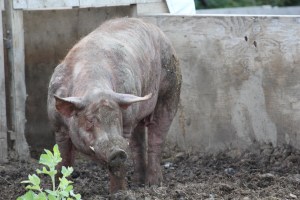
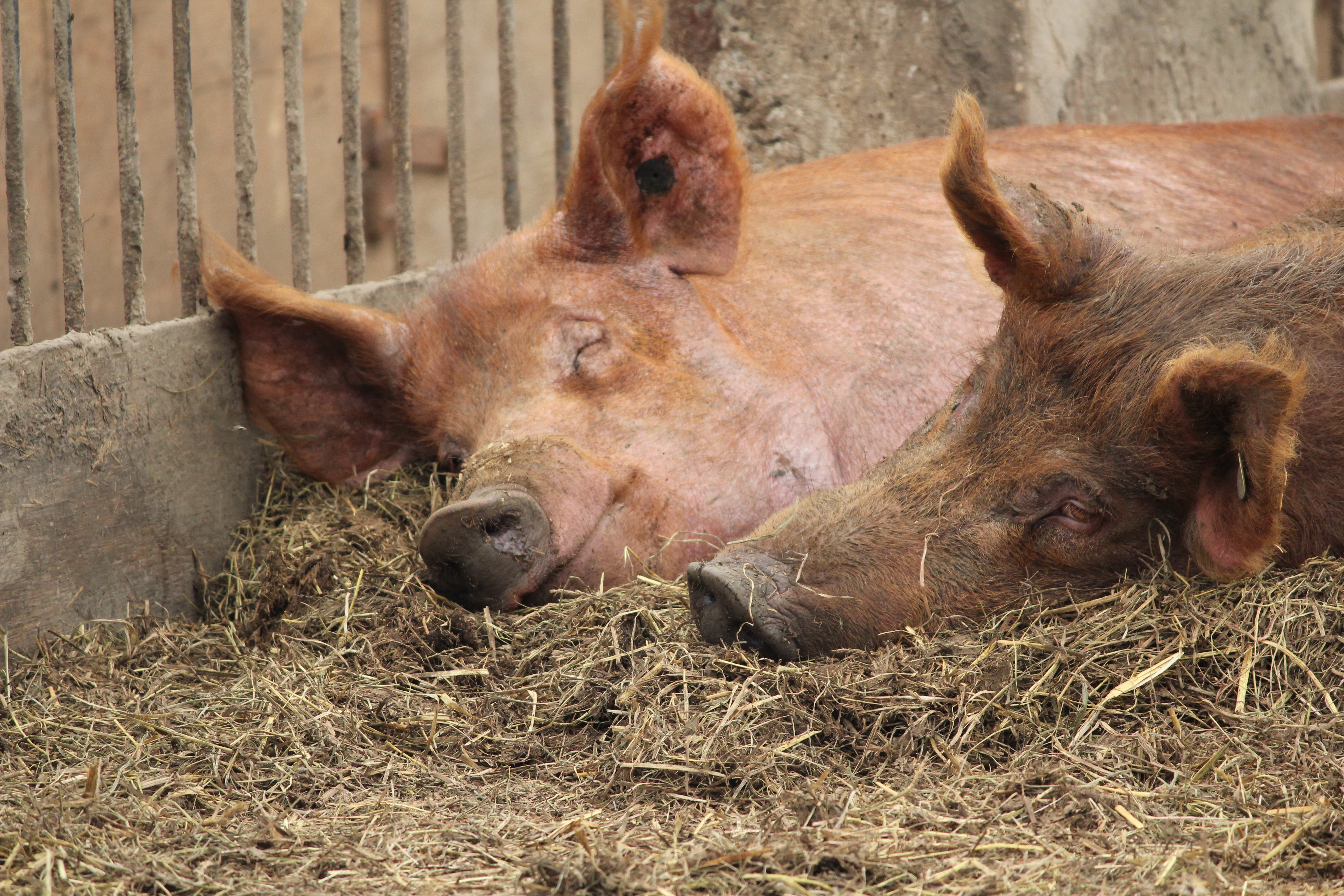
Rodney is a 6-year old Tamworth bought from the High Meadows Farm in Delhi, NY. As a breeding boar, he will live out his days in the barn. TGG.
PERTH COUNTY, ONTARIO—Fred de Martines recalled a visitor to his family’s pig farm who anticipated horror and abuse. According to Fred, she actually had nightmares and expected to see “blood on the wall.” Once inside the farm, she was relieved to see that her expectations were unmet.
Fred is often dismayed about the bad reputation that pig farmers have in the public eye. The misinformed opinion that all farm-raised pigs suffer a terrible existence is in his opinion: “nonsense.” To educate people on how the de Martines family run their farm, they built a viewing room so visitors can see how their hogs live.
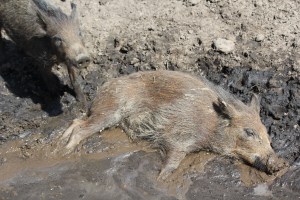
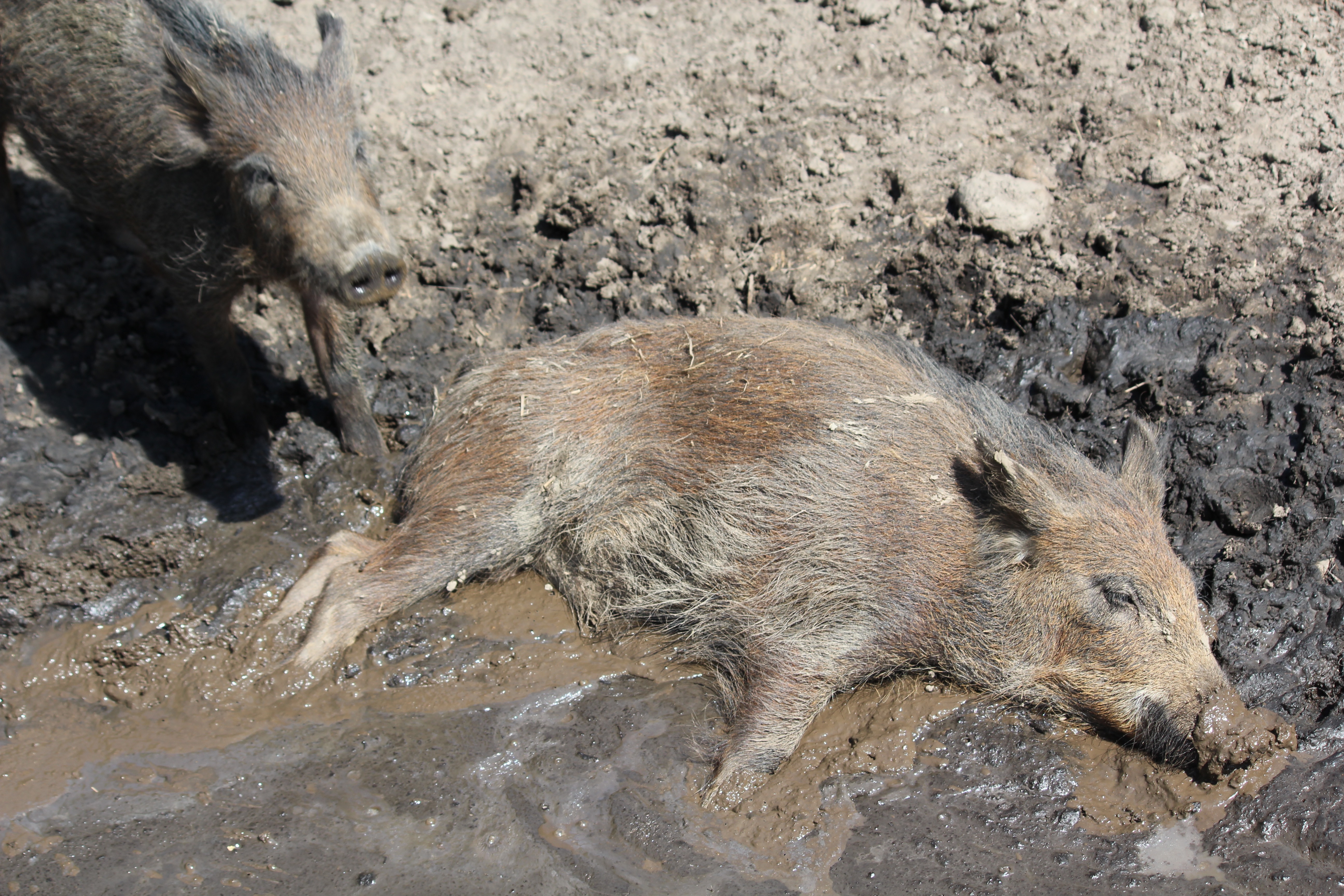
A European Wild Boar piglet stays cool in the mud. Did you know that pigs do not have sweat glands and would die of heat stroke if they didn’t have mud pools to keep cool? Otherwise, hogs prefer to be clean. TGG.
Fred said that he and his family are proud to raise their pigs in a humane, dignified way. Still, there exists a duality of purpose in raising animals humanely.
One, demand for high quality meat. And two, the respect of animals or the prevention of cruelty of animals. In his opinion, the two go together. Keeping the pigs happy is best for the farmers, the consumers, and the pigs.
When pigs are stressed their growth is stunted, and so the process of getting them to weight is also slowed. To exemplify this, Fred notes that the hogs don’t grow as fast during the summer when they endure more stress in the extreme heat. Consequently, the market receives less pork during the hotter periods.
Although stress cannot be avoided, there is necessary and unnecessary stress. Fred said that, like man, “there are bullies in the playground, and there are bullies in the barn.” When one hog intimidates others, Fred separates the bully so the herd doesn’t experience unneeded stress. Yet, like people, pigs are social and prefer to not be alone. If a hog needs to be separated from the pack because of misbehavior or sickness, it cannot be subjected to solitary confinement.
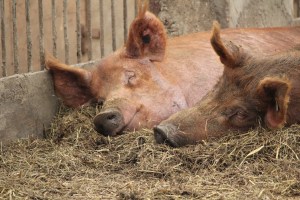
Hay is an important part of the de Martines’s pigs’ diet. It’s good for their stomachs, providing fiber and preventing ulcers. It also supplements the pasture-feed during the long winter months when there is no pasture to graze on. TGG.
“They need companionship whether they’re bullies or not,” explained Fred. In such a scenario the segregated pig must have a suitable partner so that even the bully does not become stressed from isolation.
The necessary, unavoidable stress that eventually comes is reduced as much as possible for the de Martines’s hogs. The pigs are delivered by trailer to the abattoir on late Saturday afternoon. Because moving is stressful, Fred ensures they are given about a day and a half to settle into their new barn, which is ventilated and provides full access to drinking water. Keeping the hogs unstressed up to the moment of the kill ensures that the meat is more tender, and thus, a higher quality product, but also maintains as little cruelty to the animals as possible.
The De Martines family provides several elements on the farm that let the pigs live a stress-free, healthy lifestyle. They offer open space for grazing, shelter for shade, mud holes to keep cool, showers to keep clean, and faucets to drink water.
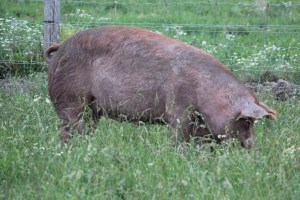
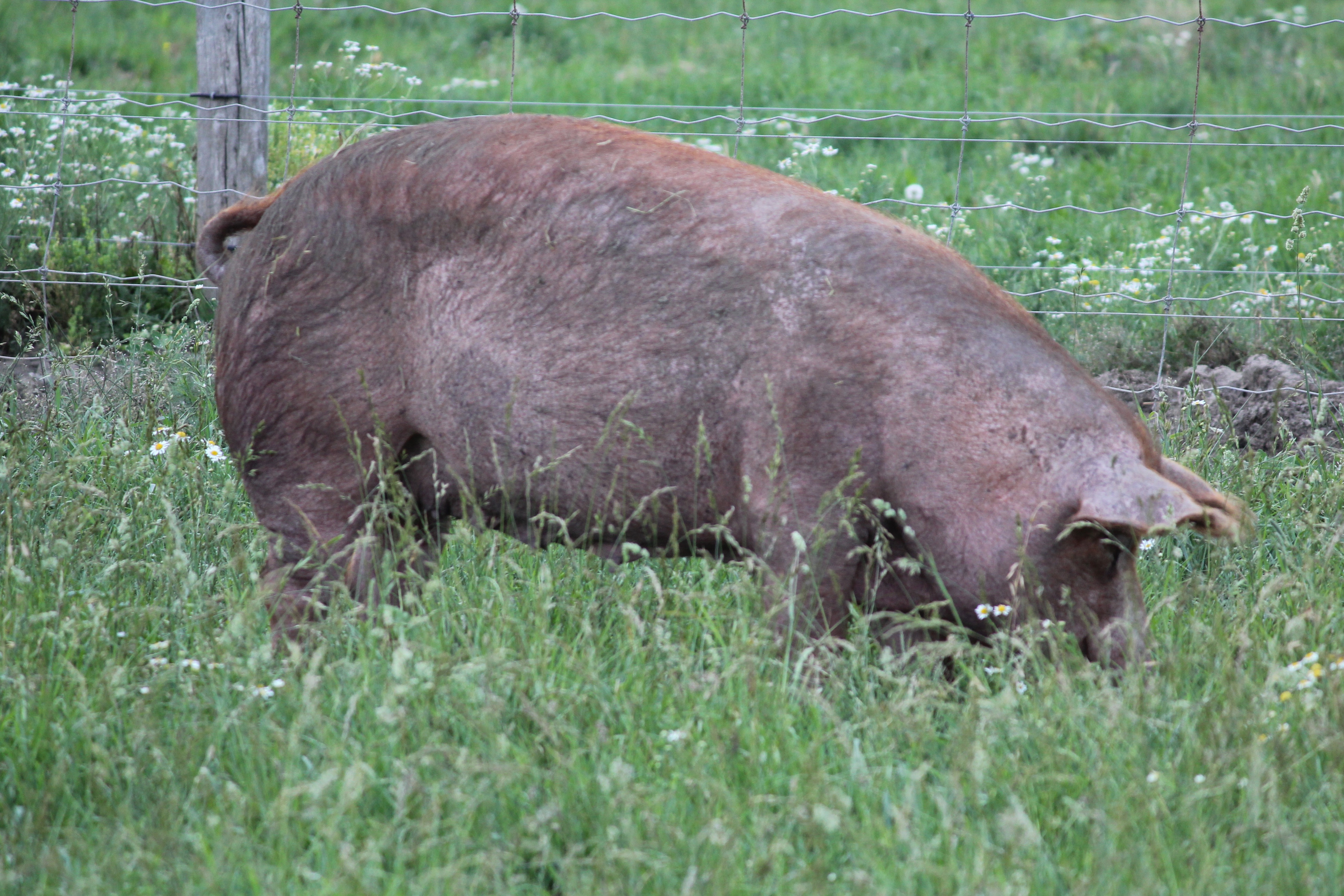
The Tamworth, originally called “the Irish Grazer,” was imported from Ireland to England by Sir Robert Peel in the early 19th century.¹ This breed is marked by its reddish brown skin and erect ears. TGG.
Also, the pigs eat a healthful diet of barley, corn, oats, wheat, and hay. The heritage breeds, the Tamworth, Berkshire, and European Wild Boar, are pasture-fed, so hay is necessary because there is no pasture in the winter. Yet, they feed the heritage breeds hay yearlong because it is good for their stomachs. It provides fiber, which helps prevent ulcers and keeps them regular.
“Pigs love hay,” said Fred. “If given the choice, pigs will eat hay instead of grass.”They even like lounging on it. The family makes their hay with grass, alfalfa, and clover.
The commodity pigs, which are less expensive than the heritage breeds, eat more corn than barley because they are raised for speed. Corn causes pigs to grow faster than the other feeds do.The commodity pigs provide the basic pork that is sold to the average consumer at a lower price. The heritage breeds are more expensive and eat mainly barley and less corn.
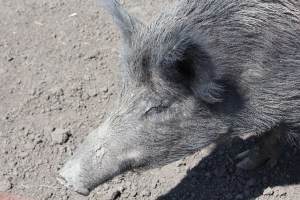
The Tamworth, originally called “the Irish Grazer,” was imported from Ireland to England by Sir Robert Peel in the early 19th century.¹ This breed is marked by its reddish brown skin and erect ears. TGG.
Also, the heritage breeds take 50% longer to grow than the commodity pigs, not only because they eat less corn, but according to Fred, “heritage breeds don’t have the genetic makeup to grow as fast as non-heritage pigs.” They have been living the same way for centuries—of course, this is what makes them heritage breeds. These breeds can be fed corn to grow quicker, but the final product is, in Fred’s opinion, a much lower quality.
The de Martines family farm is not organic because they spray their fields for weed control. Fred explained that they do not have time to hoe thousands of weeds that grow. However, they do not use GMO seeds for their crops, and they do not use hormones, antibiotics, or animal byproducts in the raising of their pigs.

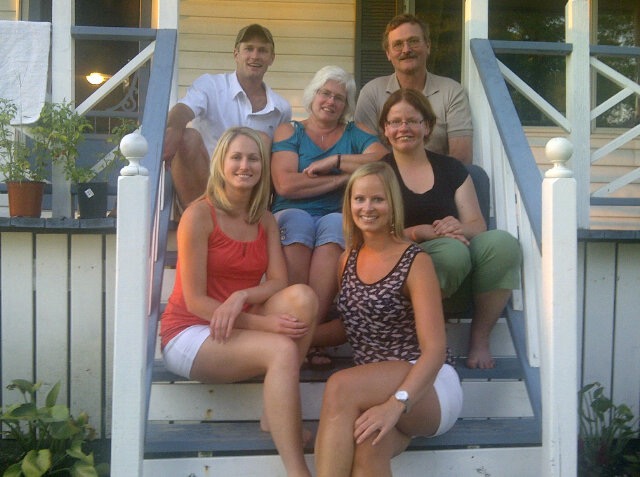
The de Martines Family: In the middle is Ingrid, counterclockwise from upper right is Fred, their son, Mark, and their daughters, Bianca, Rachel, and Yvonne. Mark and Yvonne also work on the farm. Originally from Deurne, Netherlands, Fred and Ingrid moved to Ontario in 1979. Photograph provided by Fred and Ingrid.
The family chooses to keep their sales within the Province of Ontario. This helps them maintain their farm at a manageable size, and allows them to run their operation in a profitable yet humane fashion.
If visiting Toronto, you can try their pork at The Black Hoof restaurant.
If you would like a tour of the farm, call Fred and Ingrid at (519) 393-6846 or visit their website for more information:
Perth Pork Products ltd.
References
1 Rath, Sara. The Complete Pig: An Entertaining History of Pigs. Voyageur Press, 2004.
2 Ibid.



 The Good Gusto